Field Work
Community & Culture
Residencies
Collaborations
In Plain Sight
“By car, Michael Genovese and photographer/film-maker Jon Lowenstein travelled the U.S. conducting interviews with survivors of forced labor to bring awareness to the extreme cases of victimization, which were happening in plain sight. A remarkable group of people, who endured varied levels of deception and abuse, shared their stories of debt bondage, human trafficking, child labor, and prostitution. From Washington D.C., through the East Coast, into Central Florida to New Orleans and Dallas, they worked with safe houses, labor rights organizations, and individuals, to better understand their unfortunate circumstance. Genovese and Lowenstein traced these intimate stories through photography and video, experiencing the psychic residue left behind in small towns, truck stops, trailer parks, and hotels where these incidents took place, and continue to occur…”
> Continue reading below
-
By car, Michael Genovese and photographer/film-maker Jon Lowenstein travelled the U.S. conducting interviews with survivors of forced labor to bring awareness to the extreme cases of victimization, which were happening in plain sight. A remarkable group of people, who endured varied levels of deception and abuse, shared their stories of debt bondage, human trafficking, child labor, and prostitution. From Washington D.C., down the East Coast, into Central Florida to New Orleans and Dallas, they worked with safe houses, labor rights organizations, and individuals, to better understand their unfortunate circumstance. Genovese and Lowenstein traced these intimate stories through photography and video, experiencing the psychic residue left behind in small towns, truck stops, trailer parks, and hotels where these incidents took place, and continue to occur.
The project resulted in an exhibition at Chicago at Art Works Projects that included the documentation by Genovese and Lowenstein, and presented Nina Berman's photographs from her on-going investigation about the subject. Exhibition programming included a roundtable discussion with other artists, advertising creatives, non-profit service providers, and law-enforcement officers, outlining a public engagement campaign aiming to raise awareness and funds to benefit human trafficking victims. -
P.S.
(2008-2012)
Michael Genovese’s paintings emerge from accident rather than intention. Using unplanned photographs taken by his iPhone—often captured from inside his pocket without aiming—Genovese finds beauty in the overlooked. These images, archived and curated from digital debris, become the source material for new oil paintings. What begins as a glitch or error is transformed into something slow, tactile, and contemplative…
> Continue Reading
-
-
> Image archive of carvings made from 2008-2012
-
New World School of the Arts, Miami, FL. Visiting Artist, (2011-12)
Frost Art Museum at Florida International University, Miami, FL. Visiting Artist, (2011-12)
South Florida Cultural Consortium Fellowship (Miami-Dade), Miami, FL. (2010-2011)
Northern Illinois University School of Art and Design, Dekalb, IL. ARTLAB Artist-in Residence, (2010)
The Fountainhead Studios, Artist in Residence, Miami, FL (2009-2012)
Perez Art Museum, Brick by Brick Teaching Artist in Residence, Miami, FL (2010-2011)
Museum of Contemporary Art Chicago, Chicago, IL. Winter Artist in Residence, (2008)
Department of Cultural Affairs Chicago, Artist in Residence, Chicago at the Cultural Center, Chicago, IL. (2008) -
P.S. / P.P.S, Patricia and Phillip Frost Art Museum, Miami, FL (Solo Exhibition and residency)
Institutionalized, Museum of Contemporary Art Chicago, Chicago, IL (Solo Exhibition and residency)
Contemplation station, Pedway, Chicago Cultural Center, Chicago, IL (Solo Exhibition and residency)
Sign Language w/ Juan Angel Chavez, Downtown Gallery, University of Texas San Antonio, San Antonio, TX (Curated by Kimberly Aubuchon)
Sign Language w/ Juan Angel Chavez, Unit B Gallery, San Antonio, TX (Curated by Kimberly Aubuchon)
It’s not the heat, it’s the humility, OHWOW, Miami, FL (Solo Exhibition)
We all we got, Packer Schopf, Chicago, IL
Confection, OHWOW, Miami, FL (Group Exhibition)
Time+Temp, Hollywood Art and Cultural Center, Hollywood, FL (Group Exhibition)
Carol Jazzar, Miami, FL (Group Exhibition)
Writ Deep, Jack Olson Gallery, Northern Illinois University School of Art and Design, Dekalb, IL, Curated by Shannon Stratton (Group Exhibition)
New Work Miami, Miami Art Museum, Miami, FL (Group Exhibition)
Public Scribing, White Walls, San Francisco, CA
Between here and there, Selections from the permanent collection, Miami Art Museum, Miami, FL (Group Exhibition)
It ain't fair 2, OHWOW, Miami, FL (Group Exhibition)
All-Media Biennial, Arts and Culture Center of Hollywood, Hollywood, FL (Group Exhibition)
Write Now, Chicago Cultural Center, Chicago, IL (Group Exhibition)
Those who do, New World School of the Arts, Miami, FL (Group Exhibition)
It ain't fair 3, OHWOW, Miami, FL (Group Exhibition)
Escape the Room w/ Michelle Weinberg, Mosquera Collection at Farside, Miami, FL (Group Exhibition)
Peace Tower, Mark di Suvero, Chicago Cultural Center, Chicago, IL (Collaborative Exhibition) -
Loyola University, North Campus, Chicago, IL
Pedway, Chicago Loop, Chicago, IL
Chicago Cultural Center, Chicago, IL
University of Texas San Antonio, Downtown Gallery, San Antonio, TX
MCA Chicago, Gold Coast, Chicago, IL
Unit B Gallery, San Antonio, TX
Miami Art Museum, Miami , FL
Florida International University (Campus wide) Miami, FL
Patricia and Phillip Frost Art Museum, Miami, FL
Hollywood Art and Cultural Center, Hollywood, FL
OHWOW, Miami, FL
Black Bar, Overtown, Miami, FL
Girl Power, Liberty City, Miami, FL
The Fountainhead, Little Haiti, Miami, FL
North Miami Beach High School, Miami Beach, FL
Next Art Fair, Merchandise Mart, Chicago, IL
Hialeah High School, Hialeah, FL
Bal Harbor Shops, Bal Harbor, FL
YWCA, Overtown, Miami, FL
Mater Academy East High School, Little Havana, Miami, FL
The Barnyard Community Center, Coconut Grove, FL
Northern Illinois University School of Art and Design, Campus wide, Dekalb IL
Shooters, Hialeah, FL
Lord Stanleys and the Annex, Dekalb, IL
CARTA/FIU, Miami Beach, FL
The Gaansavort, Miami Beach, FL
Private Residence, (MAM) Miami Beach, FL
Wynwood Art Fair (MAM) Miami, FL
420 Lincoln Road, Miami Beach, FL
Soho House, Miami Beach, FL -
“See For Yourself: Artist Working On-Site," MCA Chicago Magazine, Winter Edition, 2008
MCA Winter Residency by Phil Ponce, Chicago Tonight, Art Beat, PBS/WTTW 11, February, 2008
Lemon Poppy Seed: Multitasking Creativity, Klanten, Robert, H. Hellige. Die Gestalten Verlag, Berlin, 2008
The Upset: Young Contemporary Artists, Klanten, Robert, H. Hellige, and S. Ehmann. Die Gestalten Verlag, Berlin, 2008
ART LIES: Contemporary Art Quarterly, Sign Language (San Antonio), by Ben Judson, Issue #60, 2008
“Chicagoans in Transit.” Mikkalo, Erika. Proximity Magazine, October 2008
Pedway project, Apple, Lauri. Newcity, Chicago, IL, 2008
UTSA hosts 'Sign Language' ” by Arturo Almeida, UTSA Today, San Antonio, TX, July 2008
“Signs of the Times” by Elda Silva, San Antonio Express, San Antonio, TX, July 2008
“Truth in Advertising” by Sarah Fitsch, San Antonio Current, San Antonio, TX, July 2008
New American Paintings, #77, Curated by Raphaela Platow, Midwest Edition, 2008
Playful Type: Ephemeral Lettering and Illustrative Fonts, Klanten, Robert, H. Hellige. Berlin: Die Gestalten Verlag, 2009
Dazed & Confused, Issue #75, London, UK, 2009
L’Officiel Hommes, Paris, FR, 2009
Michael Genovese: It’s Not the Heat, it’s the Humility.” Lowdown Magazine, Issue #65, May 2009
NBC 5 Miami (feature), 2009
Words in here, Versal 8, Garr M. Megan. Amsterdam, NL. Artist Feature, p.28, 2010
NIU Today, Artist in Residence, Dekalb, IL April 2010
“Art of a scribe and the building of a community”, Tschida, Anne. Knight Arts, John S. and James L. Knight Foundation, April 25, 2011
Blend, OHWOW: A Fabulous Ménage, Claire Breukell, Amsterdam, Netherlands, 2011
Escape the Room, Batet, Janet. Artes y Letras, El Nuevo Herald, Miami, FL., Jan. 23, 2011
"Escape this room." Tschida, Anne. Knights Arts, John and James L. Knight Foundation. February 8, 2011
New York Times Round Table at Florida International University, Miami, FL, 2012
Bright, Daab Publishing, Cologne, DE, p.162,311. 2012
Post New, Permanence, Interview w/ James Oliver, New York, NY, June 2012
“He said, we said,” Suarez de Jesus, Carlos. Miami New Times, Miami, FL, April 19, 2012
Institutionalized
Museum of Contemporary Art Chicago
Winter Artist in Residence
A new body of work comprised of large-scale paintings of urethane on gessoed canvas, which visually derive from screen grabs of keyword image searches, specifically, the grid that briefly appeared while images were loading on his mobile phone. Proportionally scaled to the screen ratio, these paintings replicate the exact color and pattern that occurred during each image query interim. For over ten years, social practice and archives have remained an active interest for the artist, as he has worked through various methods and diverse pursuits toward accumulating material.
-
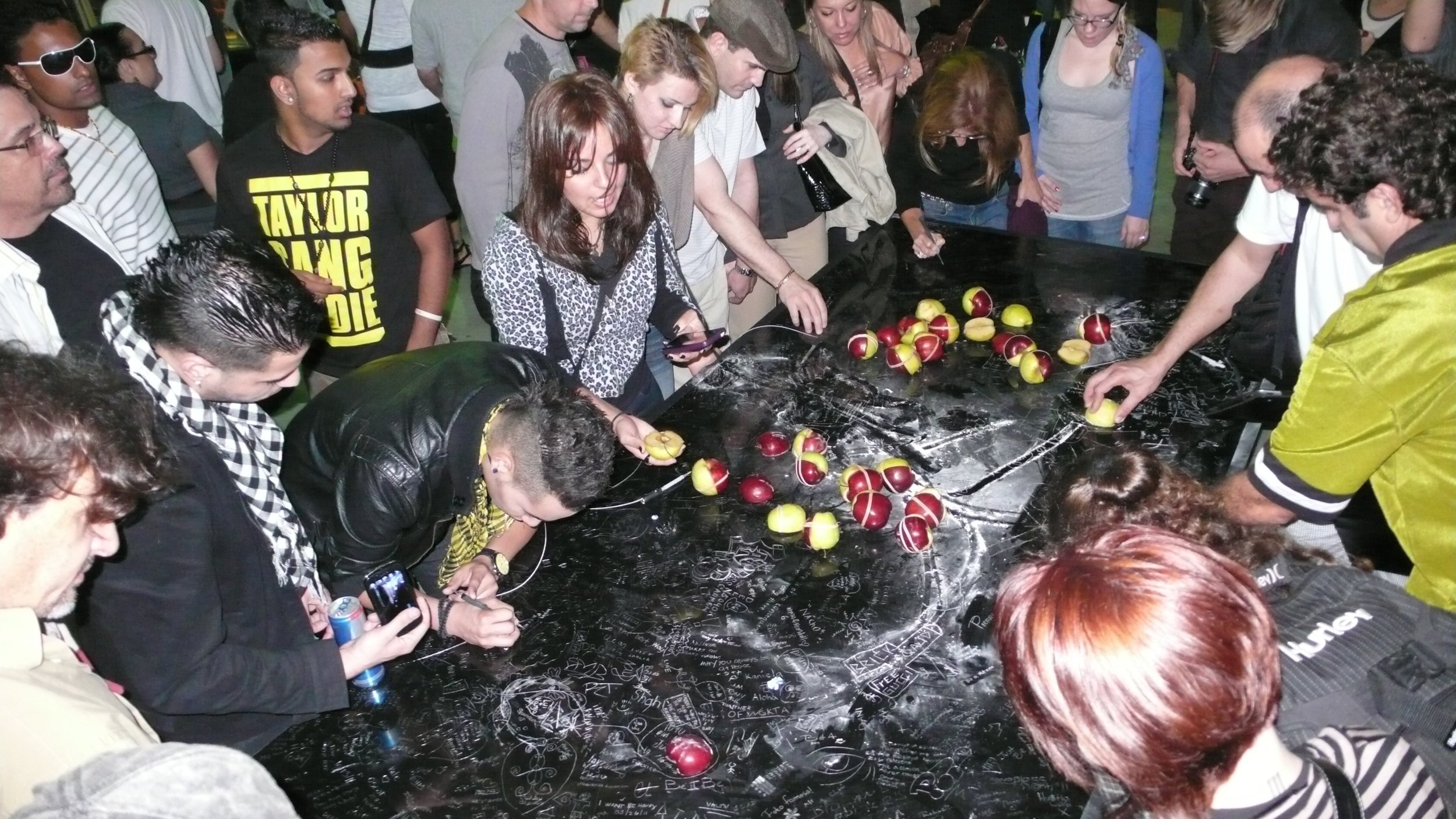
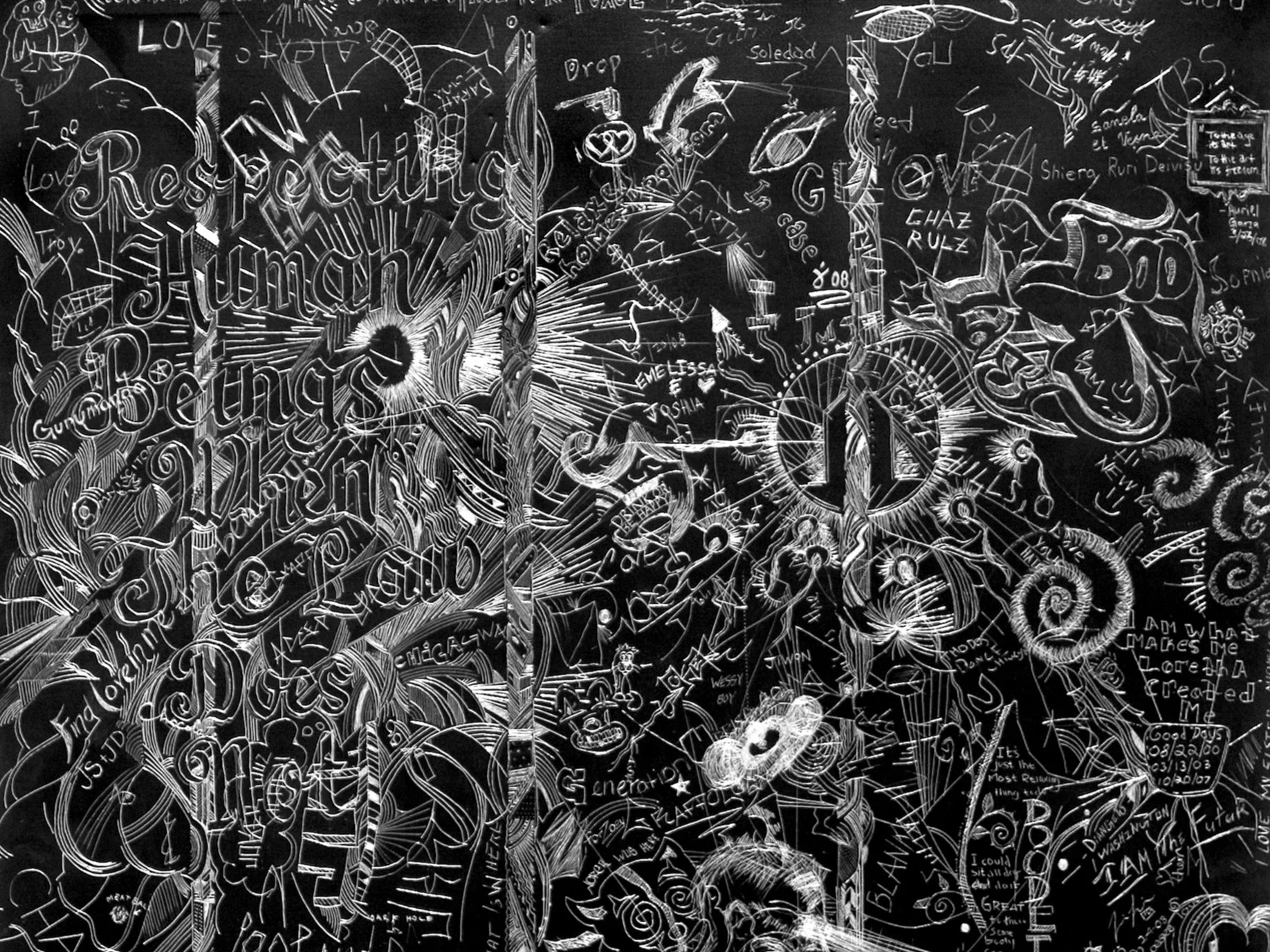
• An interactive collaborative metal carving project was installed where Genovese embellished the drawings with museum visitors.
• Push cart sculpture designed feed visitor and staff fresh fruit in the lobby throughout the duration of the residency. The push cart was exhibited as a sculpture and gifted to a push cart vendor fully stocked.
• A Zora Neale Hurston quote was the inspiration for a painting in the main lobby. The painting was transformed by visitors that translated the iconic text into their native languages, that included Urdu, Japanese, and Korean.
• A performance of administration duties was on view for visitors to read in real time, the unedited correspondence between the artist and his galleries as they organized his next exhibition. -
MICHAEL GENOVESE ARTIST IN RESIDENCEJANUARY 15–FEBRUARY 24
O
n any given day at the MCA you can see work by living artists, but rarely do you go to a museum and see a living artist at work. We’re changing that. More and more you will have op-
portunities to see artists making art in the MCA. From January 15 to February 24, Chicago artist Michael Genovese will create an installation in the Robert B. and Beatrice C. Mayer Education Center.
Genovese explains, “What I’m going to do as a part of an on going social sculpture project or hand-lettering project is re-create a food vendor cart from scratch. I’m going to trick it out from top to bottom, keeping it as true to the making of vendor carts as I possibly can. I’m going to paint it, decorate it, set it up with coolers, an umbrella, fruit, the whole nine yards, to a tee, almost like I’m making a still life, but with actual objects, based on memory. And then in the spring, I’m going to look for a food vendor who has the crappiest cart and ask him if he’d like to trade. And then examine the idea or the art of the transaction. What am I up to? Why would you want to give me this? The sort of social dynamic that will be involved in that.”
Genovese is interested in not only showing the process of making art but also his day-to-day experience as a professional artist. It’s not all romantic creativity: it’s sending e-mails, answering the phone, and looking for commissions. He’s also setting up his o;ce on-site, complete with a computer and phone, so you can see both practice and practical at work, or what Genovese calls “the art of the business of art.”
See all of it—the hand lettering, the vendor cart, the entire installation process, and Genovese on the phone promoting himself and his work, as artists must. Come see the reality of art-making at the MCA.
-
Know Wave
In conversation with William J. Simmons
Volume 2WJS: So, after much research, I have established that you are, in fact, an artist, and not the Pittsburgh mob boss. With this out of the way, let’s get started. These new paintings seem to stem from your interest in collaborative artistic practice within the public sphere, especially your work at the Frost Art Museum, yet there is an entirely different mode of information gathering taking place.
MG: Great, glad you were able to clear that up. After this Q&A, we should plan a little fishing trip. We’ll grab a bottle of Grappa, get a box of cannolis, and go shoot the shit about the old days. We’ll make a day out of it.
WJS: Only if we can also BBQ and play touch football and wrestle playfully and talk about how hot Jessica Simpson is and plan the week’s fantasy roster.
MG: OK, but let’s get to this first. Right, I faced a set of problems with that project. There are thousands of comments, drawings, and conversations from around the country, which were transcribed, that I’ve been left to deal with. I’m using that information as source material to see how the subject matter can develop, change, and morph by way of researching images online. The initial results were images that didn’t correspond correctly to the terms, but came up due to other embedded information within the file source. Algorithmic color-coding is an unseen component of the image as it loads, and that’s what led me in this direction.
WJS: I love the idea of the “unseen,” as this is exactly what you are doing – you’re mining color that is only visible for a few moments from the text you are searching. In this way, you are getting at some kind of interior space, that may not be initially legible, on what looks like highly polished, hard-edged abstract paintings. After all, the origin of abstraction was exactly the search for something that is perpetually unseen – a universal language, some sort of expression without speech that transcends culture, and enters the realm of the spiritual. The other component of the “unseen,” however, is an element of control. Even the most minute experiences we have on our phones are regulated. Is there something nefarious latent in your project? I’m reminded of that very famous Barbara Kruger image/book Remote Control (1994). There is also a connection to Sarah Charlesworth’s Modern History series, in which information and socio-political relationships become reduced to formal relationships.
MG: I’m looking for that quiet and undefined space between information, and what you refer to as the interior space – that flawed moment in translation, color, and order, right before it fails. Charlesworth’s Modern History series is a perfect example. In that work, the entire written context was removed, leaving you with just a stark black and white image, with a floating set of editorial photos, and a header. By way of redaction, you were faced with drawing your own conclusions from the void. These are similar in that way, though the cues of information are further removed to set up issues with context, color, and perception. Deception isn’t designed into the image, but if a painting is contextualized with a provocative title, for example Stereotypes or Faith, the viewer is bringing their history of the subject to the image, and it can be construed as subliminal.
WJS: Since you bring up the inherently flawed nature of these images, and their intensely personal nature, I think this is a great place to consider the sense of longing I see in these paintings. Just when you think lines are going to connect, or at least create something formally sensible, things fall apart. To quote Yeats, via Achebe: the center, indeed, cannot hold. This off- kilter sense of order bespeaks an urge for unity, for completion (I use this word advisedly, with all its connotations), for some sort of resolution.
MG: The paintings are based on the time in between the search and the resolution. The idea of waiting is what I’m working with, where something concrete has previously happened while in a state of pause before another tangible situation occurs. Similar to the format of our conversation, the time intervals between responses – the thoughts that appear and disappear as time lapses. It can be as aggravating as it is welcome. It's imbalanced and unresolved, with a will to connect to a collective unconscious.
-
-
Patricia and Phillip Art Museum
Visiting Artist Program
Miami, Florida
“The Patricia & Phillip Frost Art Museum at Florida International University presents its first visiting artist program featuring Michael Genovese with P.S. (2008-2012). P.S. is a process-focused project, that has taken place in Florida, Texas, California and Illinois, that collects the spirit and attitude of Americans. In this iteration of the project, students are invited to carve their thoughts, views and ideas into blank surfaces placed in social spaces throughout the university’s campuses. These reflections and ruminations capture the essence of the individual, community, and university as a whole. This unedited information, which mirrors a range of perspectives during a time of change, are studied in content, form and function as a starting point for the creation of new work by Genovese..”
-
-
> View the archive of work made during the residency.
-
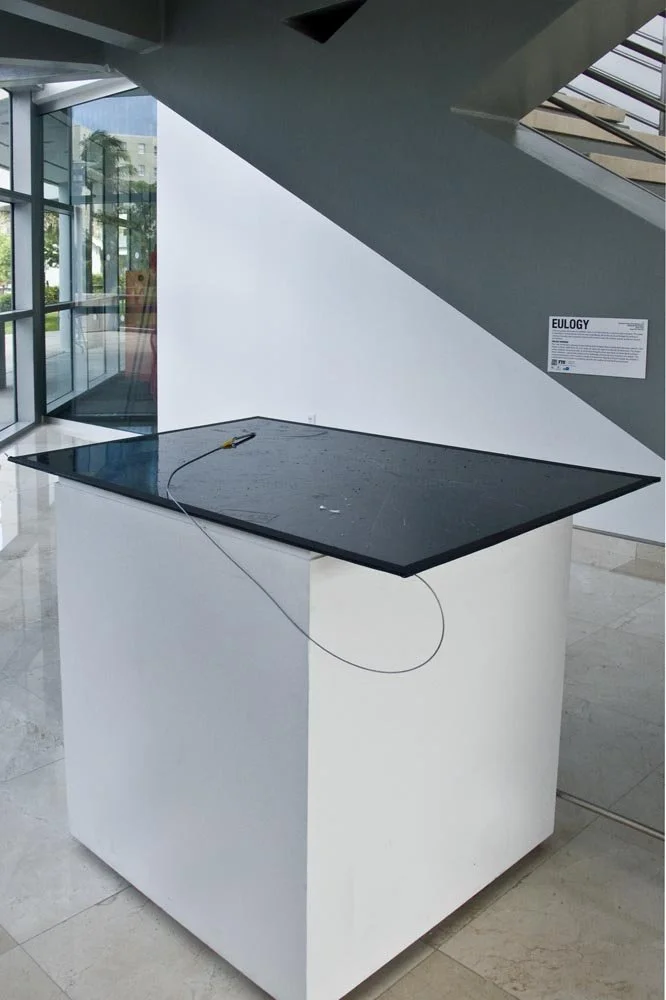
• Aluminum panels were installed throughout campus and in social spaces throughout surrounding area. Each location was provided with an attached stylus and a placard that described the projects the theme, with instructions.
• Education outreach programming for high schools throughout Miami-Dade County. The classes included a lesson on work from the permanent collection and its interpretation as a collaborative drawing incised onto the composite aluminum plates.
• New World School of the Arts Internship. 4 students were selected to participate in the project. They archived and participated in the , transcribing, translations, and digital production.• Lectures and workshops were performed for various classes throughout the University.
• We participated in a protest of the 1% in downtown Miami, where we brought plates to record the messaging and set up a sign making station where we made signs solidarity with the protestors.
•An on-line repository and archive was designed as a part of the permanent collection that houses the transcription, translations, documentation of the process and digital imaging made during the 1 year tenure.
• A two part exhibition was installed that featured the plates made during the residency and a response exhibition that showed how the information informed Genovese’s practice.
• An edition was produced with a small plate, stylus, a prick and pounce tracing, and pounce bag. Ed. 25 -
-
Joilet
Paris London Hong Kong
Chicago, Illinois
“Genovese’s cracks are nickel plated steel. They crawl the wall like rivulets of ore to be mined, river ways carving up the drywall and heartache, cast and preserved bijoux that gives the room character. They are copies, these cracks, that remember a history that marks another matter, but here cut from their origins, they are meditations. Pauses that are divorced from spectacle and dazzle, yet manage to pay respect or honor in their heft and their might and subtle shine the great events, the affairs, the phenomena whose full weight is brought to bear and registered, as fracture. A life lived is inscribed by the cracks and the fissures; the big events are permanently worn and remembered”
-
Joliet
Essay by Shannon R. Stratton
In university my friend, a former ballerina, discovered she had caused a stress fracture in her shin from working out too much at the gym. Sometimes described as a hairline fracture, I imagined watching this crack creeping across my friend’s leg like a sheet of ice crazing under my foot as my full weight came to rest on its cool surface. Or, to put the emphasis on the “stress,” I imagined my entire body slowly shattering when the weight of anxiety or fear or loneliness could be felt too heavily on my mind, my shoulders, my heart.While I’ve seen cracks and crazes, and fractures and fissures, the imagining of the incident, the slow traveling of the fractures path as it tears, at a meandering pace, throughout he matter that it is dividing, has resonance. It’s a sharp pang in the stomach you let slip between your fingers the moment , the person, the place, and it falls away from your grasp for good. It’s an ache as a distance stretched out between you and a loved one when the last words exchanged drive you further apart and you both watch, dumbfounded, as this last breach gapes wider, it’s a twinge in your heart as you taste the bittersweet. It’s the distress that crumples the mind, fragmenting into a million little cavities that hold a million little details that can no longer be held together. It’s the sting of disappointment that splinters the ego, as bad news comes to rest. And it is also the stitch, that creeps down your side, marking a moment of exertion when your body feels the last burst of its efforts in a sensation that both severs and joins it, a sensation of both pain and triumph.
Is this what it means to suffer fracture? Is it only pain? An emotional rending that leers its way through nerves and blood and bone and flesh and heart and brain like a surge of electricity cuts through the sky? And why then, is it only sometimes beautiful? Lightening surely fills us with awe, but the soft crazes of a porcelain tea cup or the fissure that worms its way through marble, have a sense of history that soothes us, while the crack that bursts through plexiglass is an eye sore. The plexiglass is ruined, it’s purpose marred and impaired by the crack, but the marble has acquired more character. The fissure is at home with the gently worn depressions where a million feet have been given support as the beat a path to and fro.
I work my way through this emotional inventory of pangs and twinge, stitches and stings, and wonder which mar the person and which lends him character? What aches make us beautiful, while others weaken our core?
Michael Genovese titles his exhibition “Joilet” The not so little town that butts up against Chicago, who’s weight perhaps tore it from Cook County early on, to become the seat of Will County to the SouthWest. Its great prison looming large throughout it’s life, until it closed in the early 2000's as its buildings aged into hazardousness. Joliet’s prison weaves itself into art into American Poetry and Music and film, a great looming icon of the great fractures that weaken us all, in the most complicated off ways, systematically, socially, politically.
And then there is the Des Plaines river, that cuts Joliet in two. The River that brought its namesake, French Canadian explorer Louis Joliet, to camp on a mound no in the South West of the city in 1673. A mound that was later mined until it became a depression. It’s excavation, through perhaps a thousand stabs of a pick ax or blasts of dynamite, leaving a hollowed out summit, deflated onto itself.
Or perhaps Joliet conjures something else, as the nucleus of fracture; a city that has lived its life as a transportation hub with riverways and railways and highways meeting meeting and radiating from here. An allusion to the heart from which a fracture emerges. The site of impact as well as the site of termination, as just as many ways come to an end here, as they are gotten underway.
Is the nucleus of the pang, the twinge, the ache, the heart? Does Joliet shimmer and become once again Juliet? Now, Shakespeare’s heroine for whom the intensity of young love shatters her very core, yet in the end reconciles two families fractured from years of feuding. A dagger plunged into a heart; is at once a violent stitch that repairs a rift.
For an artist who has spent much time with writing and the meaning wrought by inscription, whether invited or in the case of graffiti, renounced, Genovese’s cracks are also another script. But unlike a script that fills in the gaps, it instead marks an event or the event makes the mark and the particulars of the story are vacated. The marks that are left, the cracks the fissures are a record whose language we are fluent with only effectively, allowing legibility only through filling the lacuna on either side of these fractures on their left or right, before or after) with our own collisions.
Genovese’s cracks are nickel plated steel. They crawl the wall like rivulets of ore to be mined, river ways carving up the drywall and heartache, cast and preserved bijoux that gives the room character. They are copies, these cracks, that remember a history that marks another matter, but here cut from their origins, they are meditations. Pauses that are divorced from spectacle and dazzle, yet manage to pay respect or honor in their heft and their might and subtle shine) the great events, the affairs, the phenomena whose full weight is brought to bear and registered, as fracture. A life lived is inscribed by the cracks and the fissures; the big events are permanently worn and remembered. - Shannon R. Stratton
-
Joliet
Exhibition review by Monica Westin for Newcity, Chicago
Michael Genovese’s linear wall reliefs mimic the everyday cracks in pavement, walls and other human structures that surround us; they also serve as traces and indexes of the less tangible fractures around us. His current exhibition at Paris, London, Hong Kong (the new gallery’s second show), “Joliet,” references the city that brands itself the “crossroads of Mid-America” and has historically served as both a railway transportation hub and a site for adult and juvenile prisons. Genovese, originally from Chicago, uses these local associations to his advantage, giving the slick, nickel-plated, mirror-polished steel cracks that crawl across the gallery space more political and historical weight. But the formalisms of the cracks themselves stand alone as repositories for abstract imagery from natural and invented worlds: like stitched seams, imagined lines of constellations, and uncanny growth of strange plant life, they seem filled with forces of gravity and grace, dripping down walls or attempting to scale and branch. The overall effect recalls Charles Ray’s famous declaration about “Hinoki,” on view at the Art Institute of Chicago, that he was trying to “breathe intentionality into” the found rotting log that he copied in a wooden sculpture. Nickel-plated pipes and occasional sculpture offer counterpoints, as do some apples of different colors cut in half and rubber-banded together — a suggestion that we ought to take the show somewhat playfully — and the artist book “Lines and Cracks and Zebras and Horses,” which combines Genovese’s photographs of found cracks with shapes that echo them.Author Bio
Monica Westin is an arts writer and historian of rhetoric based in Oakland. A regular contributor to Artforum.com (reviews) and BOMB (interviews), Monica’s criticism, essays, and interviews related to art and aesthetics have also recently appeared in PBS’s Art21, Art Forum, ,The Believer, The Brooklyn Rail, Raw Vision, VICE technology blog Motherboard, and 3 Quarks Daily. Since moving to the Bay Area in 2013, her writing has appeared locally in SFAQ and Daily Serving -
-
Post-Script
Curated by Klaudio Rodriguez
Patricia and Phillip Art Museum
Miami, Florida
Post-Script is a 2 part exhibition featuring the work made during a one year Visiting Artist tenure at the Patricia and Phillip Art Museum in Miami, Florida. The studio practice was informed by programming designed to collaborate, record, and interact with the University and its neighboring communities. Interactive art work, lectures, internships, and education programs were integrated, to weave the creative process into the cultural fabric to be able to collect information that would be used to inspire new work. Over 70 collaborative aluminum plates were carved in public spaces throughout the University and Miami-Dade County. They included 12 themes that ranged from stereotypes to faith, and documented the zeitgeist through carving and drawing.
The exhibition presented the plates as large silhouettes inspired by the artists Genovese was studying in the permanent collection, as well as the architectural profiles found on campus, and exhibition design. Other work included mirrored silhouettes of ancient tablets with hand engraved transcriptions in a codex with local languages, Spanish, English, and Haitian. In addition to the plates a wall relief was fabricated from a traced crack found on the University grounds. It was recreated out of slag steel, nickel plated, mirror polished, and pinned to the wall. The vitrine housed printed collages of the internet research and found objects that functioned as illustrative ephemera from the project.
-
Post-Script
Post-Post- Script -
He Said, We Said
Miami New Times
Carlos de Jesus Suarez
“What sets Michael Genovese apart from most artists is that the Miami-based talent typically engages an audience as a part of his creative process. And the ambitious proposal that snagged him the 2011-12 Visiting Artist title at the Frost Art Museum is no different. Genovese created sixty baked enamel finished aluminum plates and installed them throughout the Florida University Campus and other South Florida social spaces. He then invited the viewer to carve their thoughts, beliefs, or ideas into the, riffing on fifteen different themes including “dreams,” faith,” “stereotypes,” and “censorship.” Those who who engaged with the works left a lexicon of symbols and multilingual commentary that invested the objects with an unusual Rosetta Stone-like nature. The public input doesn’t end there. A second group was recruited to interpret these “P.S.” plates by transcribing the scribbles and markings into text, creating an on-line archive recording the wildly disparate descriptions. The artist then filtered these reactions and commentary to create an original body of work. The result is “P.S.-P.P.S.,” an artist call and response dialogue with all types of broader implications.” -
Michael Genovese pays homage to his institutional background when speaking about his vision as a visual artist. The Chicago native has had work on show at some of the leading museums in the States and when you consider this, it is not difficult to see how he made the transition into the contemporary gallery scene. Personally, I recall his exhibition entitled "It's Not The Heat, It's The Humility" in 2009 at OHWOW, which really showcased the artists progressive nature and ability to connect with collective experiences, be it social or existential. His work is about archives, permanence, and the designation of value while his concern with materiality, and the treatment of his chosen media, furthers the investigation of worth. This unique attention to a creative process which leaves no rock unturned makes for one to be appreciated on all levels and one that will make Genovese a name that will be talked about for years to come.
James Oliver: What inspired you to become a visual artist and what are your first memories of expressing your thoughts through art?
Michael Genovese: I did a residency at the Museum of Contemporary Art Chicago a few years back ("Institutionalized", Museum of Contemporary Art Chicago, 2008) that gave me the resources to sort my performance and social practice experience within the context of Contemporary Art. Prior to that, I was clueless as to where I was going and what it meant to be a committed visual artist. The experience of being immersed in the museum's culture while being put on display for the public to make sense of, turned me on.
A good first memory was watching a piece by Joseph Kosuth come down ("No Number #6 (On Color, Blue, 1991) that read " I am only describing language, not explaining anything," in place of my yet to be made painting. I chose to work within his statement for the piece and created a large exterior sign-like wall construction with hand painted text that was from a Zora Neale Hurston quote " All my skin folk, ain't all my kin folk." The painting was in the style of Mexican Black Lettering, inspired by Kerry James Marshall's, Souvenir I, (1997) and make shift signs I was studying in Mexico. During the time it was on display, I rotated paintings on the face of it that had the quote translated in 7 different languages by museum visitors and staff. The piece took on different meanings while staying rooted in concept as the language changed and morphed.
JO: What is the core philosophy behind your work?
MG: I give the bad ideas as much love as the ones I can live with. When I'm set on something, I obsessively go through the motions of trying to make the best out of it. I find value in the performance of labor at the crux of failure.
JO: How has your style of work evolved over time, since you first became an artist?
MG: How I handle my work has changed. It's become more layered. I question how I can make something that may be over looked or looked at too hard, possess a different value. Re-contextualizing and displacement.
JO: You come from an institutional background, doing work at museums in Chicago as well as public art projects. What part has this played in your evolution as an artist and to where you are now?MG: I'm into people outside of the system getting involved in aspects of the process in my work. I learn vicariously from the pedestrian factor, it's an unedited alive experience that allows for a wider range of content for me.
JO: How did you transform those years of public experience to moving into the gallery setting?
MG: I brought a public aspect into the fold of my process of making. What was interesting to me about working outside of the studio was, and still is, the experience; not the finished objects or environment.
JO: What inspires you on a daily basis and how do you transform this into your work?
MG: I try and stay aware and curious of simple things. I start with something simple that moves me. It can be a hair left in the bath tub when I'm alone, how light bleeds on to the wall through the blinds at dusk, or crack in the ceiling found before going to sleep. I find those moments and complicate them by piling on metaphorical meanings and history, then I trim it down into something that's palatable and agrees with me.
JO: You currently have an exhibition up at the Frost Art Museum, can you tell me about the concept of the works?
MG: P.S.-P.P.S is a rotating exhibition at the Frost Art Museum that is exhibiting participatory focused work and my response to it. The first show combines the unedited commentary created on the campus of Florida International University (and its surrounding area) through graffito drawing with themes that range from Stereotypes to Faith. It's the result of works created during my tenure as artist-in-residence that included the community in the making of a physical and virtual archive of the zeitgeist of students. It was presented in silhouettes that echoed some artists work I was studying like Frederick Kiesler, Marcel Broodthaers and pieces in the Frost's permanent collection by David Hockney, Louise Nevelson, Ad Reinhardt and Robert Indiana. The surfaces unraveled a dialogue that discussed sociopolitical and economic concerns and solutions, expressive memes and internet language like Pedo Bear hanging out with Freddie Mercury's sign of hope and the notorious upside table.
P.P.S is a series of studio work where the transcriptions from the plates are engraved into fractured mirror polished metal that reference silhouettes of ancient relics of civilization. Engraving the text is rooted in the performance of being a scribe. The text is translated into local languages from where they were made, and written in columns to the point of illegibility. Other works include FF'12 a collage made from researching the theme of Gender. It includes a printed screenshot from the “Something in the way she moves” music video, torn pages from the book You Must Relax, a Breath Right Strip and a polished piece of steel. The show ends with Double Day, a 13' piece of fragmented mirrored steel that is the positive relief of a wall crack.
Oliver, James. Post New, Permanence, Interview http://post-new.com/#feature=node/644 NYC., 2012 -
It’s not the heat, it’s the humility
Our house west of Wynwood
Miami, Florida. 2009
Michael Genovese’s work operates as a reflection, both in a conceptual context and a literal sense. This exhibition addresses a range of subjects, from Art History to American culture, pomposity to personal debt. The artist holds up a mirror in order to understand his identity and his role in relation to these subjects, while challenging the viewer to perform the same exercise. How we redefine ourselves, our choice, of expression, the ways we are influenced by what we read and experience, all create cause for reflection and require a measure of humility in doing so.
-
Michael Genovese’s work operates as a reflection, both in a conceptual context and a literal sense. This exhibition addresses a range of subjects, from Art History to American culture, pomposity to personal debt. The artist holds up a mirror in order to understand his identity and his role in relation to these subjects, while challenging the viewer to perform the same exercise. How we redefine ourselves, our choice, of expression, the ways we are influenced by what we read and experience, all create cause for reflection and require a measure of humility in doing so.
Genovese’s text engravings on high-polished aluminum panels are simultaneously illegible and painstakingly detailed; they are further evolved reincarnations of pulp and prose. By turning his formerly disregarded mail- unpaid bills, debt collector threats and legal documents - into sacred objects, he aims to more accurately convey the power of burden. Also, among this collection of engravings is a panel cataloging public commentary from a previous project, citing non-sensical quotes like “Tippy-toe on the pooty-side” alongside profound examples: Our dreams don’t fit on your ballot”. Another engraving plucks sections of cultural essays; from Ralph Ellison’s “ Invisible man”: You ache with the need to convince yourself that you do exist in the real world…” Two chrome-plated, twin pieces, present the myth of Narcissus- one in Spanish, the other in French.
A large scale painting, executed in a style similar to the engravings, rewrites selections from a manifesto on Futurism - a lofty art movement, full of Italian bravado, which fell short of its own expectations.” Today, let tomorrow go” is the incomprehensible message on a monochromatic black painting. In each carnation of the two-dimensional work a reflection is forced, but an obstacle exists - the process of of analysis is difficult, uncomfortable, and at times simply impossible. The overall presentation of this work is an appropriation of theories from “Art and the Power of Placement” and a nod to the bygone era of formal gallery settings.
Three large-scale sculptures continue the conversation of obstacle and experience. A porch missing its home, is preserved like giant chunk of amber containing the DNA of a tragic history. A bazaar arrangement of ordinary pipes and chains is elevated to grandiose through its nickel-plated treatment. Metal rails ate manipulated into a circular formation, grounded with casted cement footings moulded from traffic cones. The motive of this work is also an interactive one; and invitation to flex your agility on a course constructed to humiliate.
Accumulated sheets of paper, in actually, weigh less than an ounce, yet can resonate the poundage of an anvil. Genovese takes intellectual ideas and gives them autonomy to match significance, while trying to preserve their original integrity. Ten-gage aluminum panels some how feel ephemeral, and a hulking wooden sculpture still gives a fragile impression; interpretations change depending on the view.
Michael Genovese
It’s not the heat, it’s the humility
June 13- July 25, 2009
Our House West of Wynwood
3100 NW 7 Avenue, Miami, Florida
Essay by: Lydia Ruby -
We all we got.
Packer Schopf Gallery
Chicago, Illinois. 2008
Layers of neon pink and green paper painted with bold letters are plastered over the gallery wall like flyers that accumulate on urban buildings or discount signs at grocery stores. These attention-grabbing colors, created from unmixed sign paint, draw the viewer to concise yet open-ended, multilingual thoughts about society. Zora Neale Hurston's observation,"All my skin folk ain't all my kin folk,"and the artist's own mantra, "We all we got," are written in Korean, Urdu, German, French, Spanish, Polish, and Bosnian on these humble posters. In the engravings displayed nearby, the two quotes reappear alongside further social commentary and unknown names tangled within baroque patterning. Where the signs are bright, outgoing, spontaneous, and fragile, the intricate engravings on tar-colored sign substrate are dark, inward, laborious, and relatively permanent. While the signs evoke grassroots advertising, the engravings evoke dangerous and secret forms of expression, such as scratchings on trains and buses, in bathroom stalls, or on desks at the back of a classroom. Executed during his residency at the Museum of Contemporary Art, Chicago (January 15-February 24, 2008), these text-based works draw on familiar modes of communication encountered at stores or on the street in order to capture contemporary voices.
-
We all we got.
Exhibition Essay by Antonia PocockLayers of neon pink and green paper painted with bold letters are plastered over the gallery wall like flyers that accumulate on urban buildings or discount signs at grocery stores. These attention-grabbing colors, created from unmixed sign paint, draw the viewer to concise yet open-ended, multilingual thoughts about society. Zora Neale Hurston's observation,"All my skin folk ain't all my kin folk,"and the artist's own mantra, "We all we got," are written in Korean, Urdu, German, French, Spanish, Polish, and Bosnian on these humble posters. In the engravings displayed nearby, the two quotes reappear alongside further social commentary and unknown names tangled within baroque patterning. Where the signs are bright, outgoing, spontaneous, and fragile, the intricate engravings on tar-colored sign substrate are dark, inward, laborious, and relatively permanent. While the signs evoke grassroots advertising, the engravings evoke dangerous and secret forms of expression, such as scratchings on trains and buses, in bathroom stalls, or on desks at the back of a classroom. Executed during his residency at the Museum of Contemporary Art, Chicago (January 15-February 24, 2008), these text-based works draw on familiar modes of communication encountered at stores or on the street in order to capture contemporary voices.
To better record language that is alive, Genovese created this set of signs and engravings in collaboration with visitors and staff at the MCA. Avoiding static dictionary definitions, he enlisted native speakers at the museum to translate the phrases he ultimately painted on neon posters. Likewise, the intricate engravings produced during this residency were built up from messages carved by museum goers. Because of his insistence on a human element in his work, Genovese's interaction with everyday life as art has a sincerity that is lacking in the innovative contributions of Marcel Duchamp and Pop Art to this terrain. While Duchamp appropriated ordinary objects, Genovese, creates his pieces with his own hands. While Pop artists tended to aestheticize the vernacular, Genovese's work is grounded more in a collaborative process than in an aesthetic. Genovese effectively resurrects Josef Beuys' conception of "social sculpture" whereby social interaction is a work of art and every person is an artist ”without the utopian promise Beuys championed. Though his works often involve painting, then, it is clear that Genovese's medium is not strictly paint, nor is it simply industrial sign materials; he also works with the abstract media of language and human interaction.
-
